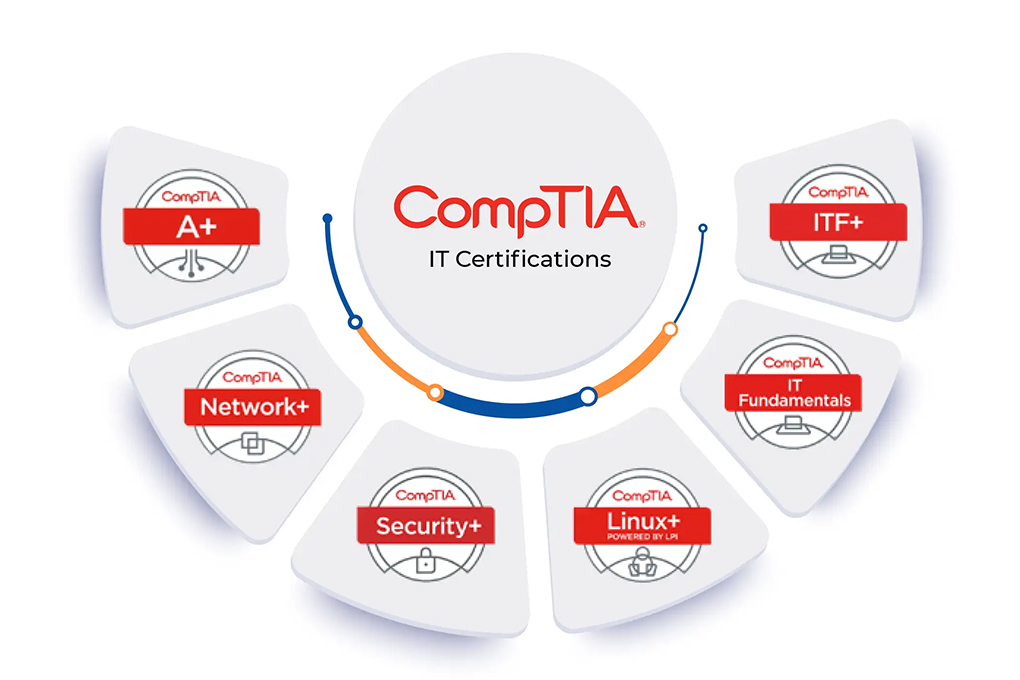
Build a bulletproof foundation in IT infrastructure. Master hardware systems, network engineering, and enterprise cyber defense to pass your official CompTIA exams.
Field: Course Overview & Key Meta Data
-
Duration: 3 Months each Certification
-
Skill Level: Beginner to Advanced (Progressive Track)
-
Learning Mode: On-Campus (Theory Lectures + Practical Lab Simulation Clinics)
-
Prerequisites: Basic computer literacy (A+ requires no prior experience; Network+ and Security+ build sequentially)
Field: About the Course
CompTIA certifications are the world’s leading vendor-neutral credentials for establishing a highly successful, global IT career. The CompTIA Infrastructure & Security training track is a elite-tier technical preparation program engineered to take students from absolute baseline troubleshooting up to defensive cybersecurity architecture.
This comprehensive curriculum strictly targets the official objective domains tested across CompTIA’s core exams. You will not simply memorize answers; you will learn how to diagnose deep hardware failures, construct enterprise network subnets, and hunt for live system vulnerabilities. By working on physical server parts, managing network testing tools, and deploying security controls inside active lab environments, you will gain the technical confidence required to pass your exams and fulfill high-paying technical roles anywhere in the international tech sector.
Field: What You Will Learn (Repeater Fields)
-
Official CompTIA Objectives: Complete, rigorous domain matching for the latest A+, Network+, and Security+ exam specifications.
-
Hardware Architecture & OS Triaging: Assemble enterprise workstations, diagnose physical faults, and support major client operating systems.
-
Vendor-Neutral Networking: Configure core routing, manage corporate switches, and troubleshoot protocol performance issues across multiple vendors.
-
Enterprise Cyber Defense: Identify threat profiles, analyze malware vectors, and implement strict risk management controls to shield systems.
-
Access Control & Cryptography: Deploy secure multi-factor authentication systems, cryptography keys, and firewall access control parameters.
Field: Curriculum Syllabus (Repeater Module)
Module 1: CompTIA A+ Core Frameworks (Hardware & OS Operations)
-
Assembling, installing, and configuring desktop, laptop, and enterprise server components.
-
Deep dive into storage technologies, RAM types, CPU architectures, and peripheral interfaces.
-
Administering, diagnostic testing, and recovery workflows across Windows, Linux, macOS, and mobile operating systems.
-
Mastering fundamental command-line utilities for local system diagnostics and software repair.
-
Operational procedures: Safety practices, environmental controls, and high-quality customer service documentation styles.
Module 2: CompTIA Network+ Core Frameworks (Infrastructure Engineering)
-
Demystifying internet architectures: In-depth analysis of the OSI 7-Layer reference architecture and TCP/IP stack.
-
Calculating advanced IPv4/IPv6 address metrics, variable length subnet masking (VLSM), and cloud addressing fields.
-
Deploying physical network setups: Setting up Cat6 cabling patterns, managed switches, and enterprise routers.
-
Configuring essential network management protocols including DNS, DHCP, NAT, and network time protocols.
-
Isolating and resolving wireless network drops, routing packet losses, and physical hardware link faults.
Module 3: CompTIA Security+ Core Frameworks (Threats & Vulnerabilities)
-
Analyzing the psychology and anatomy of modern attacks: Social engineering, malware, ransomware, and brute-force exploits.
-
Deploying threat mitigation controls: Configuring stateful firewalls, intrusion detection systems (IDS), and secure proxy layers.
-
Implementing identity management infrastructures: Role-Based Access Control (RBAC), multi-factor verification, and directory systems.
-
Understanding enterprise cryptography: Applying symmetric/asymmetric algorithms, hashing validation protocols, and SSL/TLS structures.
Module 4: Risk Management, Security Auditing & Exam Pass Strategies
-
Conducting organizational risk assessments, business impact analyses, and structuring incidence response frameworks.
-
Analyzing Security Information and Event Management (SIEM) telemetry logs to pinpoint live data breach attempts.
-
Reviewing cloud architecture security models, internet-of-things (IoT) security holes, and mobile device deployment policies.
-
Completing rigorous, timed exam simulation practice runs under live testing conditions with structured instructor evaluations.
Field: Tools & Technologies Covered (Repeater / Icons)
-
Diagnostic Tools & Hardware: Multimeters, cable testers, hardware loopback kits, open system motherboards.
-
Network Mapping Software: Wireshark packet analyzer, Nmap network scanner, IP subnet calculators.
-
Security & OS Labs: Kali Linux defensive toolsets, Windows Event Viewer, Syslog servers, OpenSSL engines.
Field: Who This Course Is For
-
IT Career Starters: Individuals seeking a powerful, globally verified entryway into technical support, helpdesk engineering, or system maintenance using CompTIA A+.
-
Systems & Network Admins: Technology personnel who want to validate their unverified field experience and scale up to core infrastructure design roles via Network+.
-
Aspiring Cybersecurity Analysts: IT specialists aiming to unlock high-paying corporate security contracts or military/government cyber roles by earning the Security+ certification.